- Valve’s new gaming Steam Machine is slated for launch in spring 2026, however costs haven’t been introduced but
- Specs spotlight main variations between the brand new system and the Steam Deck
- The Steam Machine’s processor and its specs recommend it might problem current-gen consoles
It has been literal years since rumors started about Valve’s plans for brand new {hardware} after the Steam Deck‘s launch in 2022, with whispers rising a few system that acts as a hybrid gaming PC and console setup. And now we lastly have our reply: the brand new Steam Machine slated for launch in spring 2026. Nonetheless, one of many primary questions is, how does this evaluate to the Steam Deck?
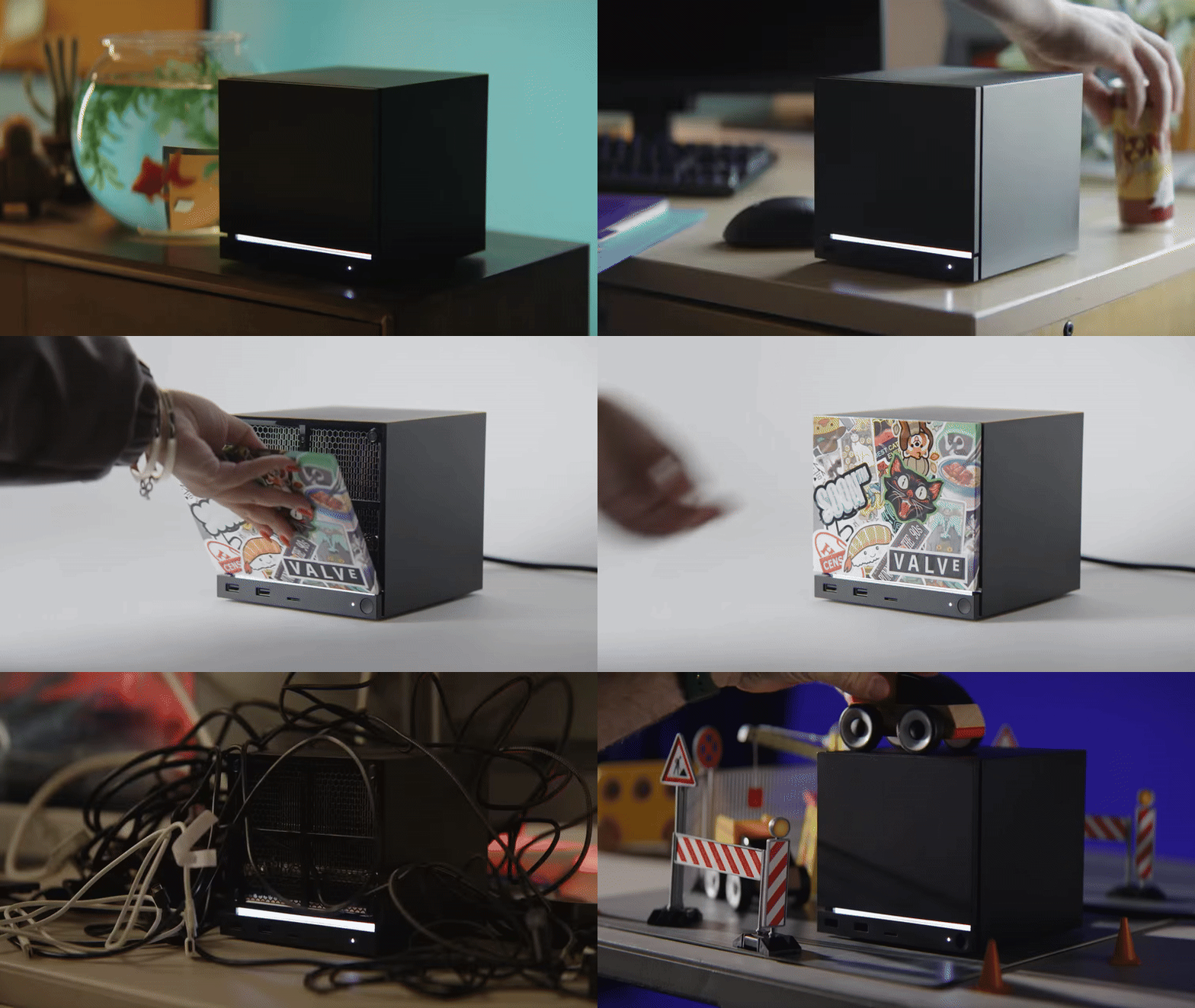
As per the specification sheet, the Steam Machine (to not be confused with the discontinued collection that began in 2014) is “over six instances extra highly effective than the Steam Deck”, because of a brand new processor and GPU which are able to efficiency that is set to exceed something the hand held can ship.
Fundamentally, the Steam Machine isn’t a handheld, so while a comparison between the two systems may not seem natural, it’s the first system to follow after the Steam Deck OLED whereas working SteamOS, and one that might doubtlessly point out what lies forward for a handheld successor sooner or later.
It is value noting that the specs could very nicely change forward of its eventual launch. However for now, let’s focus on the important thing variations between the Steam Deck and the brand new Steam Machine…
1. Steam Machine has a significantly stronger CPU and GPU
The Steam Deck LCD and Steam Deck OLED have by no means been thought-about powerhouse handheld gaming units, however have managed to remain throughout the charts among the many best handheld consoles – the place some may even say they’re the very best, because of their affordability and ease-of-use.
Valve shouldn’t be kidding when it says the Steam Machine is over six instances extra highly effective than the Steam Deck; each LCD and OLED fashions use a Zen 2 4-core CPU and RDNA 2 GPU with solely eight compute models (CPU and GPU are mixed on the APU).
With the Steam Machine, Valve is aiming for rather more energy, utilizing an AMD 6-core Zen 4 CPU, and a ‘semi-custom’ AMD RDNA 3 GPU, with 28 compute models. Not solely is there a significant step up in structure from Zen 2 to Zen 4, leading to sooner clock speeds, however the Steam Machine has 20 extra compute models, nearer to what could be discovered within the PS5 (36 compute models) or perhaps a low-end Nvidia RTX GPU.
Whereas these specs aren’t the be-all and end-all, it is sufficient to position the Steam Machine and the Steam Deck far other than one another by way of energy and efficiency, as you’ll anticipate for a PC constructed for desktop and sofa setups.
2. Steam Machine has ray tracing support and 4K gaming at 60fps

While the Steam Deck can play some games with ray tracing settings enabled (or at a 4K decision whereas sustaining first rate body charges), there aren’t many video games the place that might be attainable with out working into single-digit body charges or having to make use of aggressive upscaling.
The Steam Machine appears set on altering that, with its spec sheet explicitly mentioning ray tracing assist, and 4K gaming at 60fps utilizing AMD’s FSR upscaling methodology.
For now, this must be FSR 3, since AMD hasn’t but backported FSR 4 to RDNA 3 {hardware}, however which will change by the point the Steam Machine launches (particularly since FSR 4’s source code was accidentally leaked).
With ray tracing and 4K gaming at its forefront, this locations it nicely past the Steam Deck’s attain but once more.
3. Steam Machine has more RAM for system and games

While the Steam Deck has 16GB of LPDDR5 RAM, the maximum that can be used for the games (or more specifically, the GPU) is 4GB.
With the Steam Machine, the specifications indicate that 16GB of DDR5 RAM will be available as general system RAM, while 8GB of GDDR6 seems set as RAM allocated for gaming.
This should generally improve performance alongside the upgraded processor and GPU, and give it more headroom for sustained frame rates by reducing stuttering issues – and this is what helps the Steam Deck when increased to 4GB from its 1GB default.
4. The Steam Machine’s connectivity highlights a hybrid PC and home console nature

If it wasn’t clear enough already, the Steam Machine is a departure from the Steam Deck’s handheld nature, where a couch or desktop gaming setup is the way to go. The Steam Deck could be docked and used on a gaming monitor or TV, but that came with the handicap of losing performance at higher resolutions than 800p.
With the Steam Machine, Valve has clearly designed this to be a designated home console that can either be used on a gaming monitor or TV, with two display output ports via DisplayPort 1.4 and HDMI 2.0, and others such as 4x USB-A ports, and 1x USB-C 3.2 Gen 2 port.
There is no sign of HDMI 2.1, but HDMI 2.0 (with chroma subsampling) still allows for 4K 120Hz gaming. DisplayPort 1.4 also supports 4K 240Hz, a huge boost for any gamers on monitor setups.
There is still plenty more information to come, as there is no word on pricing yet, and the question remains whether Valve’s new gaming system will replicate the Steam Deck’s affordable price template.
Follow TechRadar on Google News and add us as a preferred source to get our skilled information, critiques, and opinion in your feeds. Make certain to click on the Observe button!
And naturally you can too follow TechRadar on TikTok for information, critiques, unboxings in video kind, and get common updates from us on WhatsApp too.

The perfect gaming consoles