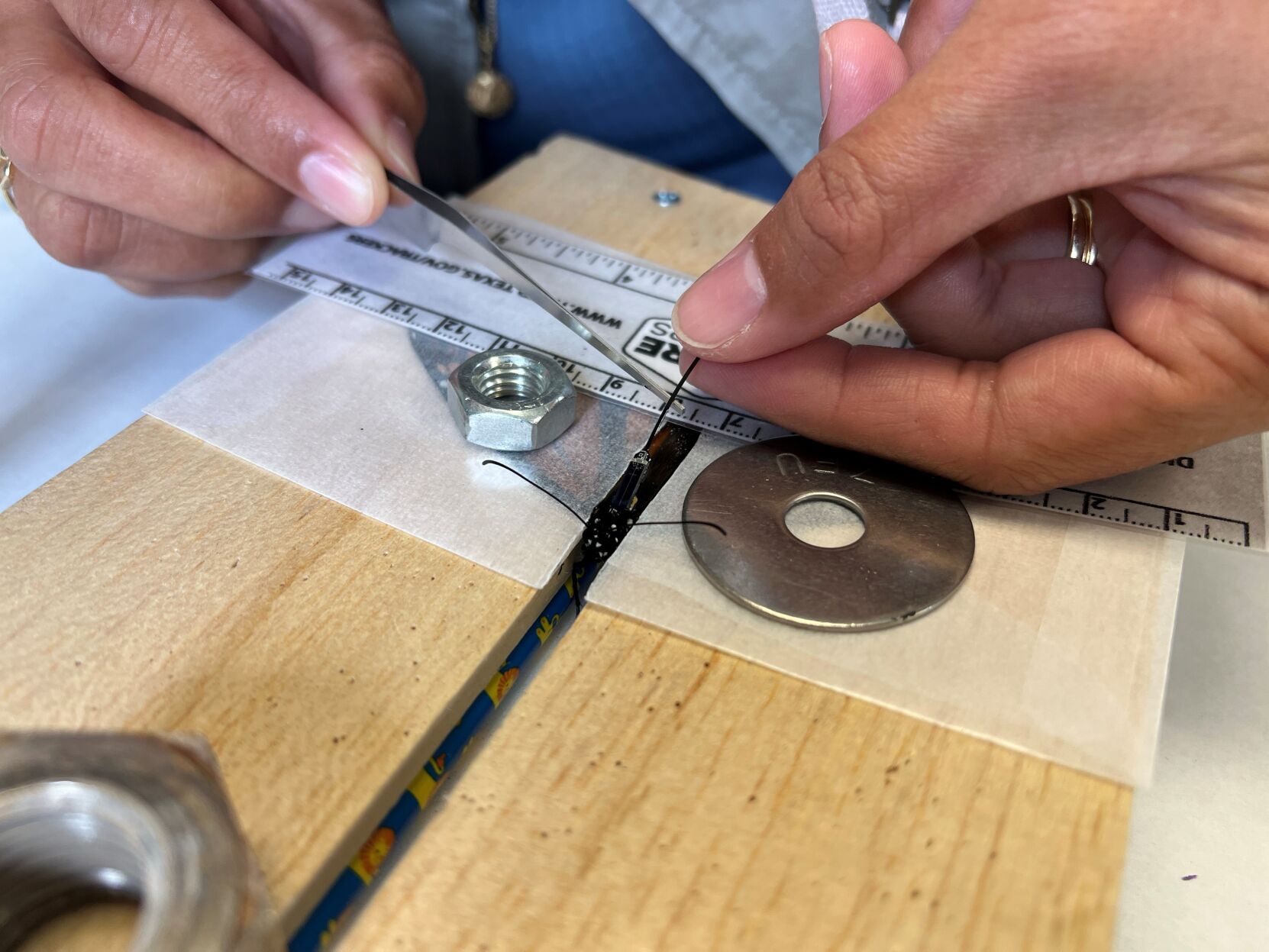
Rovina Facey, intern for Surroundings for the Americas, delicately attaches a BlūMorpho Mobile Monitoring Expertise, or CTT, tag onto a monarch’s posterior thorax Oct. 28 at Fort Hood. The BlūMorpho CTT tag, a small, light-weight transmitter, pings off cell towers and cell telephones, whereas offering updates on the butterfly’s actions and distance travelled. The data is accessible via a smartphone app known as Venture Monarch.
Dodong-EFTATX018, tagged with a light-weight transmitter, lifted off from Fort Hood Oct. 28 on its mission south. Pushed by intuition, the monarch launched into a journey spanning 453 miles in eight days. Dodong-EFTATX018 was joined by waves of orange and black butterflies touring throughout Fort Hood and in coaching areas on their annual migration journey to the south for his or her winter properties.
Fort Hood biologists with the Adaptive and Integrative Administration Staff and interns with Surroundings for the Americas are contributing to scientific analysis whereas demonstrating how navy lands serve twin functions — supporting the warfighter’s mission readiness and biodiversity for wildlife species.

Vanessa Castro, intern for Surroundings for the Americas, makes use of a mesh web to seize a monarch within the pollinator sanctuary situated off Rod and Gun Membership Loop, Oct. 28 at Fort Hood. The 2-acre footprint is accessible to the general public year-round.
This yr’s tagging effort launched an modern know-how often called the BlūMorpho Mobile Monitoring Expertise, or CTT, tags. These small, light-weight transmitters present real-time updates on butterfly actions, revolutionizing how scientists examine the monarch migration.
“The BlūMorpho CTT tags reply to cell towers and ping off of cell telephones as they obtain cell service,” mentioned Lindsy Hardy, lead pollinator biologist, AIM program. “Even in the event you’re not actively taking part within the undertaking, the CTT tags will be pinged by any mobile phone alongside the migration hall.”
Every tag transmits knowledge each couple of minutes and will be tracked via the smartphone app, Venture Monarch, which permits anybody to observe the journey of the CTT tagged butterflies. With the app, customers can view a map of the tagged monarchs together with info just like the title tag, distance flown and gender.
“Anyone can obtain the app and monitor them,” she mentioned. “You’ll be able to see the entire butterflies which have lively tags throughout america, and one which we tagged as we speak (Oct. 28) — Sue — has traveled 47 miles already as we speak. After which Mirabel, that’s one I did. She’s traveled 39 miles.”
The undertaking, initially developed to help the Cape Could Level Arts and Science Heart in Cape Could Level, New Jersey, has been in use for about three years and has expanded to incorporate monarchs. The Surroundings for the Americas program secured 16 of those tags to be deployed at Fort Hood to help the examine. Utilizing eyelash glue, the CTT tag is delicately connected to the monarch’s posterior thorax, weighing .06 grams.
“The general purpose is to show how far one singular monarch butterfly particular person can journey,” Hardy defined. “It emphasizes the significance of habitat connectivity and conservation of monarch habitat throughout the migration hall.”
Since 2017, Fort Hood’s monarch tagging program has helped to gather knowledge on 12,108 monarchs for Monarch Watch, an academic outreach program on the College of Kansas, in Lawrence, Kansas, that promotes conservation via a tagging program.
Monarchs are captured tagged with tiny stickers, offered by Monarch Watch, and positioned on their hind wings so to not inhibit their flight. The monarch is then launched with the hope that will probably be recovered by researchers and citizen scientists, on the finish of its migration, to disclose the butterfly’s path.
Round Fort Hood’s pollinator sanctuary, monarchs have been noticed feeding closely on a wide range of native vegetation.
“Normally it’s on liatris, which has just a few names — gayfeather, blazing star — however that appears to have handed with the drought,” Hardy famous. “Now we’re seeing them on bushes like kidneywood, blue mist flower, Maximilian sunflower and even curlycut gumweed and Texas broomweed.”
She described the day’s migration exercise, Oct. 28, as a “migration fallout,” a pure phenomenon triggered by climate modifications.
“At this time we’ve had plenty of wind coming from the north, shifting south, in order that’s been pushing monarchs via,” she mentioned. “The temperature is beginning to drop north of us, so it’s pushing not simply butterflies, but additionally plenty of the birds via. Due to the storm and the climate as we speak, they’re actively popping out of the jet stream down into the habitat in order that they’ll nectar.”
The workforce’s efforts join on to the mission readiness, whereas educating Troopers, households and the neighborhood how they’ll do their half to help monarchs.
“If navy households have property the place they’re stationed, they’ll plant native nectar sources and milkweed particular to their area,” Hardy mentioned. “They’ll additionally take part in citizen science initiatives like Monarch Watch and iNaturalist. It’s fully free and accessible to anyone.”